
The right model for enterprise TMS migration is a phased migration with a parallel run, executed through lane-by-lane cutover rather than a single flip-the-switch weekend. Commission a diagnostic now, and freeze your external platform contract and API contract shapes before you sign anything new. Legacy vendor lock-in gets worse the longer integration surfaces stay undocumented.
The evidence for this approach is consistent across the industry:
Enterprise TMS migration succeeds when a phased, parallel-run cutover protects in-flight shipments while an ownership registry and daily reconciliation catch problems before they compound.
| Point | Details |
|---|---|
| Use a phased model | Move through assessment, planning, deployment, and optimization, each ending in a reviewable artifact. |
| Never migrate active shipments | Cut new bookings over on a hard date; let in-transit freight finish on the legacy system. |
| Build an ownership registry | Tag every shipment by system owner so your routing layer forwards webhooks correctly. |
| Reconcile daily during cutover | Weekly checks let errors compound; daily reconciliation catches them within 24 hours. |
| Budget realistic timelines | Enterprise migrations typically run several months, sometimes longer with complex integrations. |
| FreightSuite fits this framework | Its rate management, tracking, and AI orchestration modules are built to receive phased, lane-by-lane migration. |
Four phases carry the weight of a serious enterprise TMS migration: assessment, planning, deployment, and optimization. Each phase produces a specific artifact your steering committee can review before releasing budget for the next one, which is what separates a controlled migration from a scramble.
Assessment ends with a diagnostic report: an inventory of every integration, data feed, and workflow currently running through your legacy TMS, tagged by business criticality. Planning ends with a cutover plan, the document that names who owns each carrier relationship, which lanes go first, and what the rollback trigger looks like if something breaks. Deployment ends with pilot results, real transaction data from a limited set of lanes running on the new platform. Optimization ends with a KPI baseline, the numbers that prove the new system is performing at or above the old one.
Sequencing the work this way lowers risk because you are never betting the whole freight desk on one migration event. A four-phase playbook built around assessment, planning, deployment, and optimization also creates early wins. A single pilot lane running cleanly on the new TMS after 30 days does more to build internal confidence than any slide deck.
Choosing the right migration model matters just as much as the phase structure:
Strategic functions (customer-facing quoting, rate negotiation, exception handling) usually justify rearchitecting. Operational functions (basic tracking, document storage) often tolerate a straight lift-and-shift.
Scope gets defined in the assessment phase, and getting it wrong here is the single most expensive mistake in enterprise TMS migration. Start by separating strategic functions, the ones that touch revenue and customer experience, from operational functions that just need to keep running.
Your assessment checklist should cover:
Export formats matter more than most teams expect. Structured data (customers, rates, carrier records) should move as CSV or database dumps you can validate row by row. Document-heavy records like bills of lading and proofs of delivery should move as original PDFs, not re-rendered images, so nothing gets lost in translation. Data readiness is the biggest driver of migration speed; clean exports move faster than clean code.
Pro Tip: Run your data export as a dry run 60 days before your planned cutover date. You will find broken customer records and stale carrier contacts you didn’t know existed, and it’s far cheaper to fix them now than during a live cutover window.
Data migration in freight forwarding software is unusually hard because the data is high-cardinality and time-sensitive. A single shipment touches customer records, carrier bookings, rate tables, customs documents, and accounting entries, all of which need to land correctly in the new system or reconciliation becomes a nightmare.
Your essential data sets and formats:
Build a golden-record strategy before you touch a single API. Decide which system is the source of truth for customer data, which is the source of truth for rates, and which is the source of truth for carrier profiles, then map every field accordingly. Guessing at mappings mid-migration is how duplicate customer records and orphaned rate entries end up in production.
A routing layer, sometimes called a shim, sits between your carriers and both systems during the transition. Rather than asking every carrier to update webhook URLs on your cutover date, the routing layer receives all webhook traffic and forwards it based on shipment ownership. This is a low-risk architectural pattern precisely because it avoids coordinating URL changes across dozens or hundreds of carrier relationships at once.
Reconciliation cadence during this window should be daily, not weekly. Daily reconciliation during cutover and stabilization catches a mismatched invoice or a dropped webhook within 24 hours instead of letting it compound for a week. Assign a named owner for reconciliation, typically someone from finance operations working alongside the migration lead, and give them daily standing time on the calendar for the entire parallel run.
EDI connections deserve special attention here. Carriers running EDI 204/990/214 transaction sets need advance notice before any endpoint changes, and the Worldwide Express guide to EDI tracking is a useful reference for what adoption and testing benchmarks look like across carrier partners.
The cutover itself is where enterprise TMS migration projects succeed or fail, and the operating principle is simple to state and hard to execute: you do not migrate in-flight shipments. New bookings move to the new system on a hard date. Everything already in motion rides out on the old system until it reaches terminal state, meaning delivered, invoiced, and closed.
This works because it eliminates the single riskiest failure mode in any migration: a shipment caught mid-transit with half its data on one system and half on another.
Building the playbook takes four concrete steps:
| Cutover Element | Rule |
|---|---|
| In-flight shipments | Remain on legacy system until delivered, invoiced, and closed |
| New bookings | Route exclusively to new system starting on the hard cutover date |
| Webhook traffic | Routed by ownership registry, not by carrier-side URL changes |
| Long-tail shipments | Force-closed under a defined policy once past a set threshold |
Decommissioning the legacy platform depends on how you handle the long tail: the handful of shipments that refuse to close cleanly because of a disputed invoice or a lost document. A force-close policy, for example writing off shipments 90 days past expected delivery under defined finance sign-off, prevents your legacy system from running indefinitely just to service a shrinking handful of stragglers. Without that policy, teams end up paying for two systems far longer than the migration plan ever intended.
Pilot design determines whether your first cutover builds confidence or destroys it. Pick two or three lanes that are representative of your volume and complexity but not your highest-stakes accounts, enough transaction volume to surface real issues, not so much that a failure becomes a crisis.
Core test cases to run before any lane goes live:
Pro Tip: Keep a dedicated Slack or Teams channel open for the first 30 days post-cutover, staffed by someone from ops and someone from IT at all times. Most stabilization issues get caught in the first two weeks, and a fast escalation path beats a ticket queue every time.
The 30-90 day phased framework that many managed replacements follow builds this stabilization window in by design rather than treating it as an afterthought.
Program governance needs a steering committee with real authority: typically the COO or head of operations, the CTO or IT lead, and a finance representative who signs off on cutover dates and budget releases. Below that sits a migration lead who owns the RACI for day-to-day execution, and a dedicated reconciliation owner from finance operations.
Risk controls that matter most:
Migration failures are usually operational, not technical: carrier communication breakdowns, mismatched rate data, and dropped exception handoffs cause more damage than any API bug. Staff accordingly, and bring in external migration specialists when your internal team lacks bandwidth for the parallel-run period specifically, not for the whole project.
Timeline expectations separate realistic programs from ones that blow their budget. A mid-market freight forwarder switching TMS platforms can often complete the process in a few months. Enterprise programs with deep integration surfaces and multiple regions typically run 9 to 18 months, and complex enterprise migrations factoring in multiple integrations and regional regulations can extend to two or three years.
Budget planning should account for three components:
Engage a managed migration partner when your internal IT team is already stretched thin on day-to-day operations, or when the number of carrier integrations exceeds what your team has bandwidth to test individually within your target window.
FreightSuite is built to receive exactly the kind of phased, parallel-run migration this framework describes, rather than forcing an all-or-nothing switch. Rate management and dynamic FX tracking map directly to the golden-record strategy your data migration needs. Air and ocean tracking modules support lane-by-lane pilot rollouts without disrupting shipments still active on your legacy platform, and customs brokerage workflows carry forward the compliance detail enterprise forwarders can’t afford to lose mid-transit.
AI agent orchestration, built natively rather than bolted on, is where the optimization phase pays off: once your pilot lanes are stable, agentic workflows start automating exception handling and document processing that used to require manual intervention.
Ready reference points for planning conversations:
A migration built around parallel runs and lane-by-lane cutover only works if the platform on the receiving end can actually absorb that complexity without forcing you to redesign your operations from scratch. That is the specific gap FreightSuite is built to close: rate management, financial controls, and AI agent orchestration that plug into the phased framework above instead of demanding you rebuild your workflows around someone else’s assumptions.
A discovery and pilot engagement with FreightSuite typically starts with a short diagnostic call to map your current integration surface, followed by a scoped pilot on two or three lanes so your team can see reconciliation rates and KPI performance before committing to a full cutover date. Finance leaders evaluating the switch can review how FreightSuite supports finance teams during credit control and A/R migration specifically. Case study results from prior enterprise migrations are available on the FreightSuite case study page.
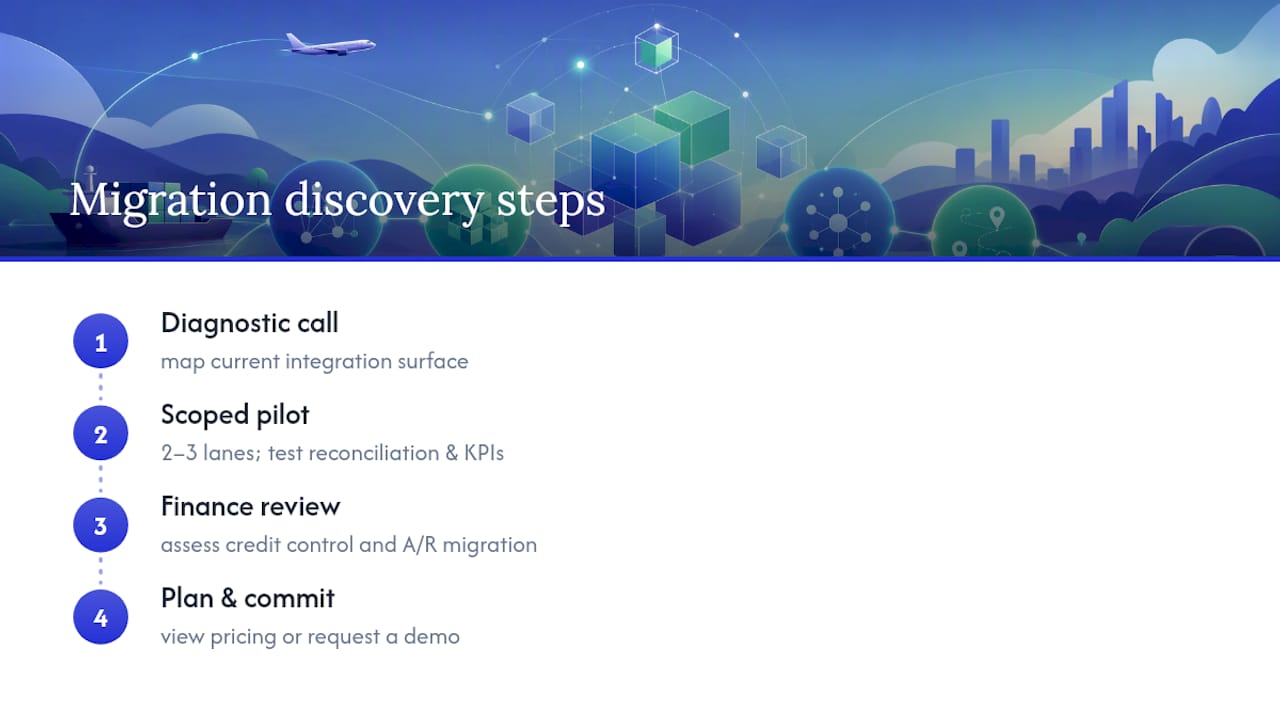
If you are ready to see costs and plan structures, check the FreightSuite pricing page for current plans, or start with a demo request through the FreightSuite homepage to walk through your specific lane mix and integration surface with a migration specialist.
The best choice depends on shipment volume and complexity, but shippers running high-volume, multi-mode freight generally need a platform with native rate management, real-time tracking, and financial controls rather than a point solution. FreightSuite is built specifically for freight forwarders and logistics companies managing exactly this complexity.
TMS stands for transportation management system, software that handles rate management, carrier booking, shipment tracking, and financial reconciliation for freight moving by truck, ocean, or air.
Rankings vary by publication and shift as platforms add features, but enterprise forwarders should evaluate systems on integration depth, AI-native automation, multi-mode support, and total cost of ownership rather than relying on a generic top-ten list.
FedEx and other large carriers use internal transportation management systems to plan routes, manage fleet capacity, and track shipments across their networks, a different use case from the multi-carrier TMS platforms freight forwarders use to manage bookings across many carriers.
Onboarding timelines depend on integration complexity, but enterprise TMS migration programs typically span 9 to 18 months, while a mid-market forwarder switching platforms can often complete onboarding in a few months using a phased, parallel-run approach.

